
Interpreting Insulin pump downloads (Under 5)
Parent guide (patients aged < 5 years)
Purpose of Guide
This guideline is for use by parents of children under 5 years and provides step by step information on how to make insulin pump adjustments from a pump download.
While this guide will help you make adjustments, if you are not sure of the changes you should make it is recommended that you discuss with your team at clinic or through the triage phone service.
Record keeping and uploading your pump
All insulin pumps have an upload system (Accuchek Connect for Roche, Diasend for Animas, and Carelink for Medtronic).
Carelink has a “personal version” and a “professional version”. The professional version provides more detailed information. Both versions provide reports to the clinical team at PMH. Please ask your team if you want to use the professional version at home.
If you are having technical problems with the uploading of your insulin pump please contact your insulin pump rep to discuss. An accurate record book is essential to make changes if you have ongoing problems with uploading the pump.
Step by Step Guide
1. General Settings
a) Check the time and date are correct
b) Check the target blood glucose value is 5.0 +/- 0.5 mmol/L
c) Active insulin time should be 3
2. General Insulin Pump Requirements
a) Blood glucose testing: Aim for 4 - 6 per day. Pre-bed testing is really important to make sure your child is within target range before going to bed and if not, to make a plan to get the glucose level into range.
b) Site change frequency: You need to change the infusion site every 3 days. Avoid sites inside the nappy that maybe prone to soiling.
c) Regular Pump Uploads: It is recommended that you upload your child’s pump regularly (for example, every 2-4 weeks) in order to have a record of current pump settings (in case the pump were to malfunction), and to see if any pump adjustments are required. It is also important to ensure you have uploaded your pump prior to attending your clinic appointment.
d) Food Bolusing: To achieve target blood glucose levels, insulin should be delivered before carbohydrate intake. This can be challenging in young children who have unpredictable eating habits and individualised approaches are sometimes required.
e) Correction Bolusing: High blood glucose levels should be corrected by delivering a bolus dose of insulin.
3. Insulin Amounts
a) How much daily insulin should there be?
In general, most children before puberty need about 0.75 – 1.0 units/kg/day once they are out of “honeymoon”. If your child has less than that, and has high blood glucose levels, it means that there isn’t enough insulin being given per day.
For example if your child has a weight of 15kg and is on 12 units per day you would calculate daily insulin as follows:
12 units divided by 15kg = 0.8units/kg/day
b) Bolus proportion of total daily dose
Bolusing at least 4 times a day is required. This will include bolusing for food and for corrections.
On a normal diet, 50 – 70% of the total daily dose (TDD) given as boluses is usually best. Basal Bolus ratios and TDD can be found on the reports as below.
4. How to check the Insulin to Carbohydrate Ratio (ICR)
The ICR tells you how much carbohydrate is covered by each unit of insulin. When you enter the carbohydrate for a meal into the pump, the ICR determines how much insulin will be given.
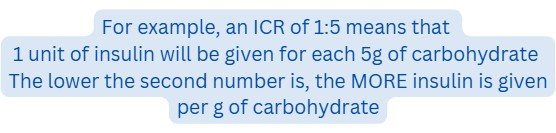
To get a general idea of what the ICR should be, use the 300 RULE:
- Divide 300 by the average amount of insulin given over the last 5 days
- This gives you the carbohydrate part of the ratio
- For example, if the average daily dose of insulin over the last 5 days is 15 units, the calculation is 300 /15 = 20 and the ICR is 1:20.
The aim is that 2-3 hours after a meal the blood glucose level should be within 2 mmol/L of premeal level. The table below shows you how much to change the ICR by if this is not happening.
Remember by making the second number in the ratio lower, the pump will give MORE insulin for any carbohydrate entered into the pump.
(TABLE)
5. How to check the Insulin Sensitivity Factor (ISF)
The ISF tells you how much the blood glucose will be lowered by each unit of insulin.
In the pump, the ISF setting controls how much extra insulin is given for a high blood glucose reading to bring the blood glucose level into range (5.0-5.5 mmol/L) within about 2–3 hours.
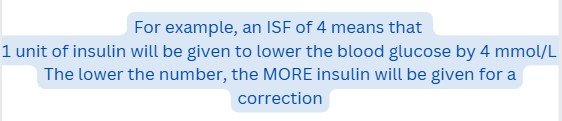
To get a general idea of what the ISF should be, use the 100 RULE:
- Divide 100 by the average amount of insulin given over the last 5 days
- For example, If the average daily dose of insulin over the last 5 days is 20 units, the calculation is 100/20 = 5 (1 unit lowers the blood glucose level by 5 mmol/L).
The aim is that 2-3 hours after a high blood glucose level has been entered into the pump, the blood glucose level should have corrected back to target.
If you find that that the blood glucose level over- or under-corrects, a change to the ISF is required, as shown in the table below.
Remember by making the number lower, the pump will give MORE insulin.
(TABLE)
6. How to change the Basal Rates
The basal insulin is the background insulin that is given slowly throughout the day. This is the hardest to change. The basal insulin should be about 30 – 50% of the total daily dose.
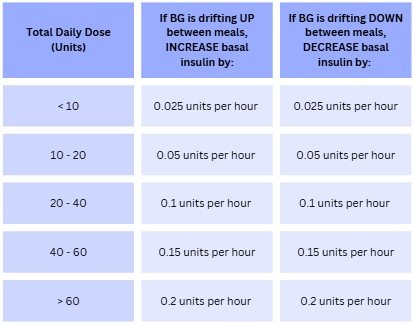
Look to see if there is a drift up or down between meals that is not explained by eating and giving too much or too little bolus insulin. If all meals require a correction (out of target) this probably means more basal insulin is needed.
More than four different basal rates are not recommended and over complicate therapy.
The table below shows how much to change basal rates by:
7. Monitoring
After making any changes, you should increase blood glucose tests including overnight tests.